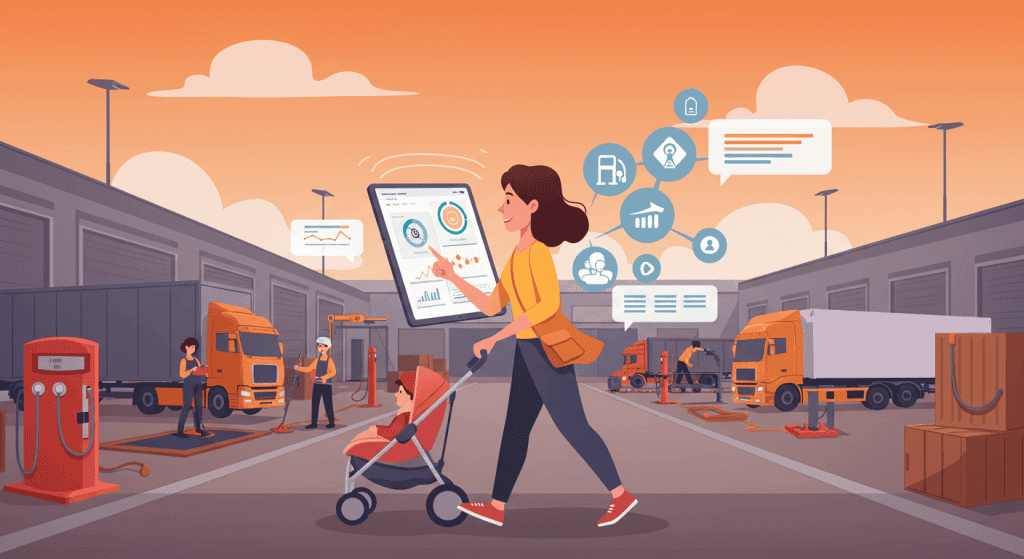
One of the most common questions we hear is surprisingly simple:
“Who actually uses fuel delivery?”
It’s a fair question. Many people assume there must be a very specific customer profile. Maybe luxury households. Maybe large commercial fleets. Maybe busy executives with no time to spare.
But the reality is far more interesting.
Fuel delivery does not belong to a single demographic, income bracket, profession, or lifestyle. In fact, one of the most consistent patterns across the industry is the absence of a “typical” customer.
Because the decision to use fuel delivery is rarely about identity.
It is about friction.
People turn to fuel delivery for different reasons, at different stages of life, under very different circumstances.
Busy parents use it because evenings disappear into school pickup, homework, sports, dinner, and the thousand small tasks that fill a week. The gas station becomes just one more stop they would rather remove.
Professionals use it because their schedules are compressed and unpredictable. Between meetings, commutes, deadlines, and travel, fueling feels like an interruption instead of a routine.
Small business owners use it because time away from operations has a direct cost. Every errand competes with something more valuable that needs attention.
Fleet managers use it because efficiency, vehicle uptime, and labor optimization are constant priorities. Fueling vehicles one by one at retail stations simply does not scale cleanly.
Boat owners use it because transporting fuel manually is inconvenient, messy, and often impractical.
Remote workers use it because they no longer pass gas stations during daily commutes.
Elderly drivers use it because convenience and safety matter more than ever.
And sometimes, customers use fuel delivery for no dramatic reason at all. They simply try it once and realize it fits their routine better.
What connects these groups is not age, income, or profession.
It is the shared desire to eliminate a recurring inconvenience.
Fueling is one of the most universal responsibilities of vehicle ownership. Everyone with a car, truck, van, or piece of equipment faces the same task. The difference lies in how people choose to manage it.
Some prioritize price.
Some prioritize time.
Some prioritize simplicity.
Some prioritize predictability.
Fuel delivery intersects with all of these priorities in different ways, which is why the customer base naturally becomes diverse.
This is also why fuel delivery often spreads through conversation rather than targeting. A neighbor mentions it. A coworker recommends it. A friend posts about it. Curiosity turns into trial, and trial turns into adoption.
Not because customers fit a narrow mold, but because the service solves a broadly shared problem.
For Juiced Fuel, this diversity is one of the most rewarding aspects of what we do. Our customers include families, executives, contractors, small businesses, retirees, remote workers, and fleet operators. Different lives, different schedules, different motivations.
Same appreciation for convenience.
Because fuel delivery is not designed for a “type” of person.
It is designed for a reality nearly everyone experiences:
Life is busy.
Time is limited.
Errands compete.
And anything that simplifies the day tends to find its audience.